 Add to Chrome
 Add to Firefox
 Add to Edge
Maneuverable-Jamming-Aided Secure Communication and Sensing in A2G-ISAC Systems
Feb 04, 2026
In this paper, we propose a maneuverablejamming-aided secure communication and sensing (SCS) scheme for an air-to-ground integrated sensing and communication (A2G-ISAC) system, where a dual-functional source UAV and a maneuverable jamming UAV operate collaboratively in a hybrid monostatic-bistatic radar configuration. The maneuverable jamming UAV emits artificial noise to assist the source UAV in detecting multiple ground targets while interfering with an eavesdropper. The effects of residual interference caused by imperfect successive interference cancellation on the received signal-to-interference-plus-noise ratio are considered, which degrades the system performance. To maximize the average secrecy rate (ASR) under transmit power budget, UAV maneuvering constraints, and sensing requirements, the dual-UAV trajectory and beamforming are jointly optimized. Given that secure communication and sensing fundamentally conflict in terms of resource allocation, making it difficult to achieve optimal performance for both simultaneously, we adopt a two-phase design to address this challenge. By dividing the mission into the secure communication (SC) phase and the SCS phase, the A2G-ISAC system can focus on optimizing distinct objectives separately. In the SC phase, a block coordinate descent algorithm employing the trust-region successive convex approximation and semidefinite relaxation iteratively optimizes dual-UAV trajectory and beamforming. For the SCS phase, a weighted distance minimization problem determines the suitable dual-UAV sensing positions by a greedy algorithm, followed by the joint optimization of source beamforming and jamming beamforming. Simulation results demonstrate that the proposed scheme achieves the highest ASR among benchmarks while maintaining robust sensing performance, and confirm the impact of the SIC residual interference on both secure communication and sensing.

SORIS: A Self-Organized Reconfigurable Intelligent Surface Architecture for Wireless Communications
Jan 30, 2026In this paper, a new reconfigurable intelligent surface (RIS) hardware architecture, called self-organized RIS (SORIS), is proposed. The architecture incorporates a microcontroller connected to a single-antenna receiver operating at the same frequency as the RIS unit elements, operating either in transmission or reflection mode. The transmitting RIS elements enable the low latency estimation of both the incoming and outcoming channels at the microcontroller's side. In addition, a machine learning approach for estimating the incoming and outcoming channels involving the remaining RIS elements operating in reflection mode is devised. Specifically, by appropriately selecting a small number of elements in transmission mode, and based on the channel reciprocity principle, the respective channel coefficients are first estimated, which are then fed to a low-complexity neural network that, leveraging spatial channel correlation over RIS elements, returns predictions of the channel coefficients referring to the rest of elements. In this way, the SORIS microcontroller acquires channel state information, and accordingly reconfigures the panel's metamaterials to assist data communication between a transmitter and a receiver, without the need for separate connections with them. Moreover, the impact of channel estimation on the proposed solution, and a detailed complexity analysis for the used model, as well as a wiring density and control signaling analysis, is performed. The feasibility and efficacy of the proposed self-organized RIS design and operation are verified by Monte Carlo simulations, providing useful guidelines on the selection of the RIS elements for operating in transmission mode for initial channel estimation.
* 12 figures, 1 table, journal
Towards Joint Optimization for UAV-Integrated RIS-Assisted Fluid Antenna Systems
Jan 29, 2026Unmanned aerial vehicles (UAVs) integrated into cellular networks face significant challenges from air-to-ground interference. To address this, we propose a downlink UAV communication system that leverages a fluid antenna system (FAS)- assisted reconfigurable intelligent surface (RIS) to enhance signal quality. By jointly optimizing the FAS port positions and RIS phase shifts, we maximize the achievable rate. The resulting nonconvex optimization problem is solved using successive convex approximation (SCA) based on second-order cone programming (SOCP), which reformulates the constraints into a tractable form. Simulation results show that the proposed algorithm significantly improves both outage probability and achievable rate over conventional fixed-position antenna (FPA) schemes, with particularly large gains in large-scale RIS configurations. Moreover, the algorithm converges rapidly, making it suitable for real-time applications
* 11 pages, 8 figures
Backscatter-Assisted High-Speed Rail Communications in Straight Tunnel Environments: Effects of Tag Number and Phase Control
Jan 05, 2026Backscatter communication is a promising technology to enhance the signal strength received by the receiver in straight tunnel environments. The impact of the number of tags and their phase adjustment on system performance remains a challenging issue though. Therefore, in this paper, we investigate the channel gain of backscatter-assisted communication with multiple tags in straight tunnels. In particular, we derive the probabilities that the backscatter link gain is greater than the direct link under adjustable and random phase assumptions by applying the Gaussian and Gamma approximations to derive tractable expressions. The simulation results show that phaseadjustable tags significantly improve the channel gain of the backscatter links compared to the random phase case. Moreover, the number of tags has an upper threshold for an effective tag deployment pattern. These insights provide valuable guidelines for the efficient design of backscatter communication systems in tunnel environments.
* 6 pages, 5 figures
Simultaneous Information and Control Signalling Protocol for RIS-Empowered Wireless Systems
Aug 06, 2025Integration of RIS in radio access networks requires signaling between edge units and the RIS microcontroller (MC). Unfortunately, in several practical scenarios, the signaling latency is higher than the communication channel coherence time, which causes outdated signaling at the RIS. To counterbalance this, we introduce a simultaneous information and control signaling (SICS) protocol that enables operation adaptation through wireless control signal transmission. SICS assumes that the MC is equipped with a single antenna that operates at the same frequency as the RIS. RIS operates in simultaneous transmission and reflection (STAR) mode, and the source employs non-orthogonal multiple access (NOMA) to superposition the information signal to the control signal. To maximize the achievable user data rate while ensuring the MC's ability to decode the control signal, we formulate and solve the corresponding optimization problem that returns RIS's reflection and transmission coefficients as well as the superposition coefficients of the NOMA scheme. Our results reveal the robustness of the SICS approach.
Dual-UAV-Enabled Secure Communication and Sensing for A2G-ISAC Systems with Maneuverable Jamming
May 13, 2025In this paper, we propose a dual-unmanned aerial vehicle (UAV)-enabled secure communication and sensing (SCS) scheme for an air-to-ground integrated sensing and communication (ISAC) system, in which a dual-functional source UAV and jamming UAV collaborate to enhance both the secure communication and target sensing performance. From a perspective of hybrid monostatitc-bistatic radar, the jamming UAV maneuvers to aid the source UAV to detect multiple ground targets by emitting artificial noise, meanwhile interfering with the ground eavesdropper. Residual interference is considered to reflect the effects of imperfect successive interference cancellation (SIC) on the receive signal-plus-interference-to-noise ratios, which results in a degraded system performance. To maximize the average secrecy rate (ASR), the dual-UAV trajectory and dual-UAV beamforming are jointly optimized subject to the transmit power budget, UAV maneuvering constraint, and sensing requirements. To tackle the highly complicated non-convex ASR maximization problem, the dual-UAV trajectory and dual-UAV beamforming are optimized for the secure communication (SC) purpose and the SCS purpose, sequentially. In the SC phase, a block coordinate descent algorithm is proposed to optimize the dual-UAV trajectory and dual-UAV beamforming iteratively, using the trust-region successive convex approximation (SCA) and semidefinite relaxation (SDR) techniques. Then, a weighted distance minimization problem is formulated to determine the dual-UAV maneuvering positions suitable for the SCS purpose, which is solved by a heuristic greedy algorithm, followed by the joint optimization of source beamforming and jamming beamforming.
Covert Communications in Active-IOS Aided Uplink NOMA Systems With Full-Duplex Receiver
Feb 05, 2025In this paper, an active intelligent omni-surface (A-IOS) is deployed to aid uplink transmissions in a non-orthogonal multiple access (NOMA) system. In order to shelter the covert signal embedded in the superposition transmissions, a multi-antenna full-duplex (FD) receiver is utilized at the base-station to recover signal in addition to jamming the warden. With the aim of maximizing the covert rate, the FD transmit and receive beamforming, A-IOS refraction and reflection beamforming, NOMA transmit power, and FD jamming power are jointly optimized. To tackle the non-convex covert rate maximization problem subject to the highly coupled system parameters, an alternating optimization algorithm is designed to iteratively solve the decoupled sub-problems of optimizing the system parameters. The optimal solutions for the sub-problems of the NOMA transmit power and FD jamming power optimizations are derived in closed-form. To tackle the rank-one constrained non-convex fractional programming of the A-IOS beamforming and FD beamforming, a penalized Dinkelbach transformation approach is proposed to resort to the optimal solutions via semidefinite programming. Numerical results clarify that the deployment of the A-IOS significantly improves the covert rate compared with the passive-IOS aided uplink NOMA system. It is also found that the proposed scheme provides better covert communication performance with the optimized NOMA transmit power and FD jamming power compared with the benchmark schemes.
Active-RIS-Aided Covert Communications in NOMA-Inspired ISAC Wireless Systems
Jun 30, 2024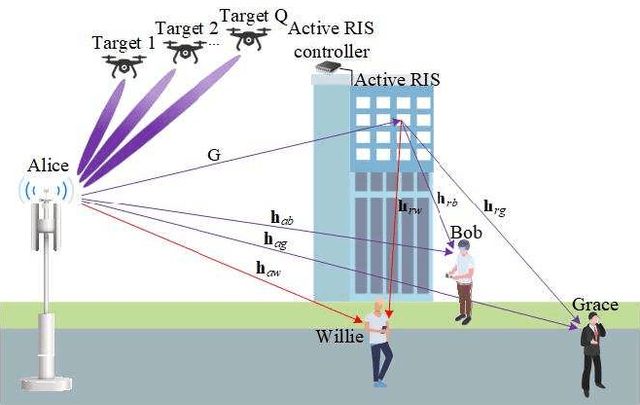
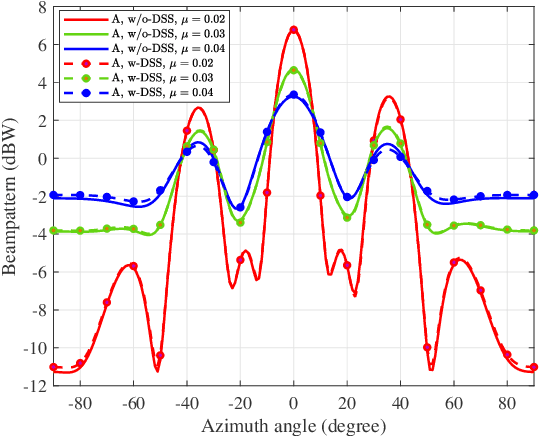
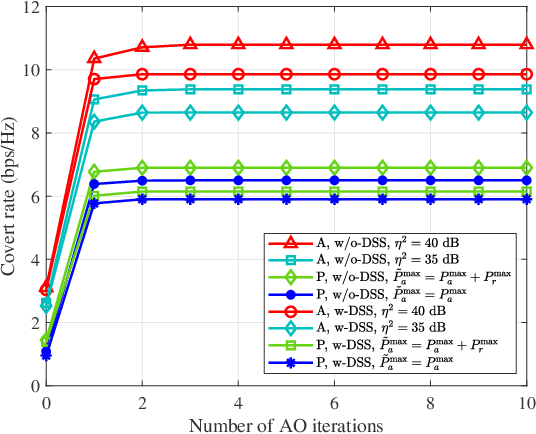
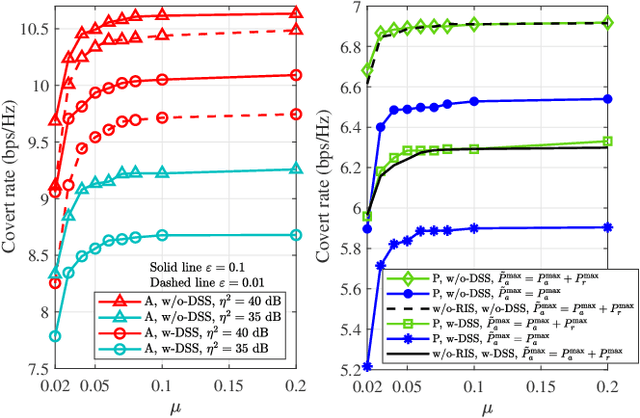
Non-orthogonal multiple access (NOMA)-inspired integrated sensing and communication (ISAC) facilitates spectrum sharing for radar sensing and NOMA communications, whereas facing privacy and security challenges due to open wireless propagation. In this paper, active reconfigurable intelligent surface (RIS) is employed to aid covert communications in NOMA-inspired ISAC wireless system with the aim of maximizing the covert rate. Specifically, a dual-function base-station (BS) transmits the superposition signal to sense multiple targets, while achieving covert and reliable communications for a pair of NOMA covert and public users, respectively, in the presence of a warden. Two superposition transmission schemes, namely, the transmissions with dedicated sensing signal (w-DSS) and without dedicated sensing signal (w/o-DSS), are respectively considered in the formulations of the joint transmission and reflection beamforming optimization problems. Numerical results demonstrate that active-RIS-aided NOMA-ISAC system outperforms the passive-RIS-aided and without-RIS counterparts in terms of covert rate and trade-off between covert communication and sensing performance metrics. Finally, the w/o-DSS scheme, which omits the dedicated sensing signal, achieves a higher covert rate than the w-DSS scheme by allocating more transmit power for the covert transmissions, while preserving a comparable multi-target sensing performance.
Impact of Inter-Operator Interference via Reconfigurable Intelligent Surfaces
Mar 01, 2024A wireless communication system is studied that operates in the presence of multiple reconfigurable intelligent surfaces (RISs). In particular, a multi-operator environment is considered where each operator utilizes an RIS to enhance its communication quality. Although out-of-band interference does not exist (since each operator uses isolated spectrum resources), RISs controlled by different operators do affect the system performance of one another due to the inherently rapid phase shift adjustments that occur on an independent basis. The system performance of such a communication scenario is analytically studied for the practical case where discrete-only phase shifts occur at RIS. The proposed framework is quite general since it is valid under arbitrary channel fading conditions as well as the presence (or not) of the transceiver's direct link. Finally, the derived analytical results are verified via numerical and simulation trial as well as some novel and useful engineering outcomes are manifested.
Extreme Level Crossing Rate: A New Performance Indicator for URLLC Systems
Jul 21, 2023Level crossing rate (LCR) is a well-known statistical tool that is related to the duration of a random stationary fading process \emph{on average}. In doing so, LCR cannot capture the behavior of \emph{extremely rare} random events. Nonetheless, the latter events play a key role in the performance of ultra-reliable and low-latency communication systems rather than their average (expectation) counterparts. In this paper, for the first time, we extend the notion of LCR to address this issue and sufficiently characterize the statistical behavior of extreme maxima or minima. This new indicator, entitled as extreme LCR (ELCR), is analytically introduced and evaluated by resorting to the extreme value theory and risk assessment. Capitalizing on ELCR, some key performance metrics emerge, i.e., the maximum outage duration, minimum effective duration, maximum packet error rate, and maximum transmission delay. They are all derived in simple closed-form expressions. The theoretical results are cross-compared and verified via extensive simulations whereas some useful engineering insights are manifested.